The Slow Death of Chart Turnover: Why No. 1 Hits Stick Around So Much Longer Than They Used To
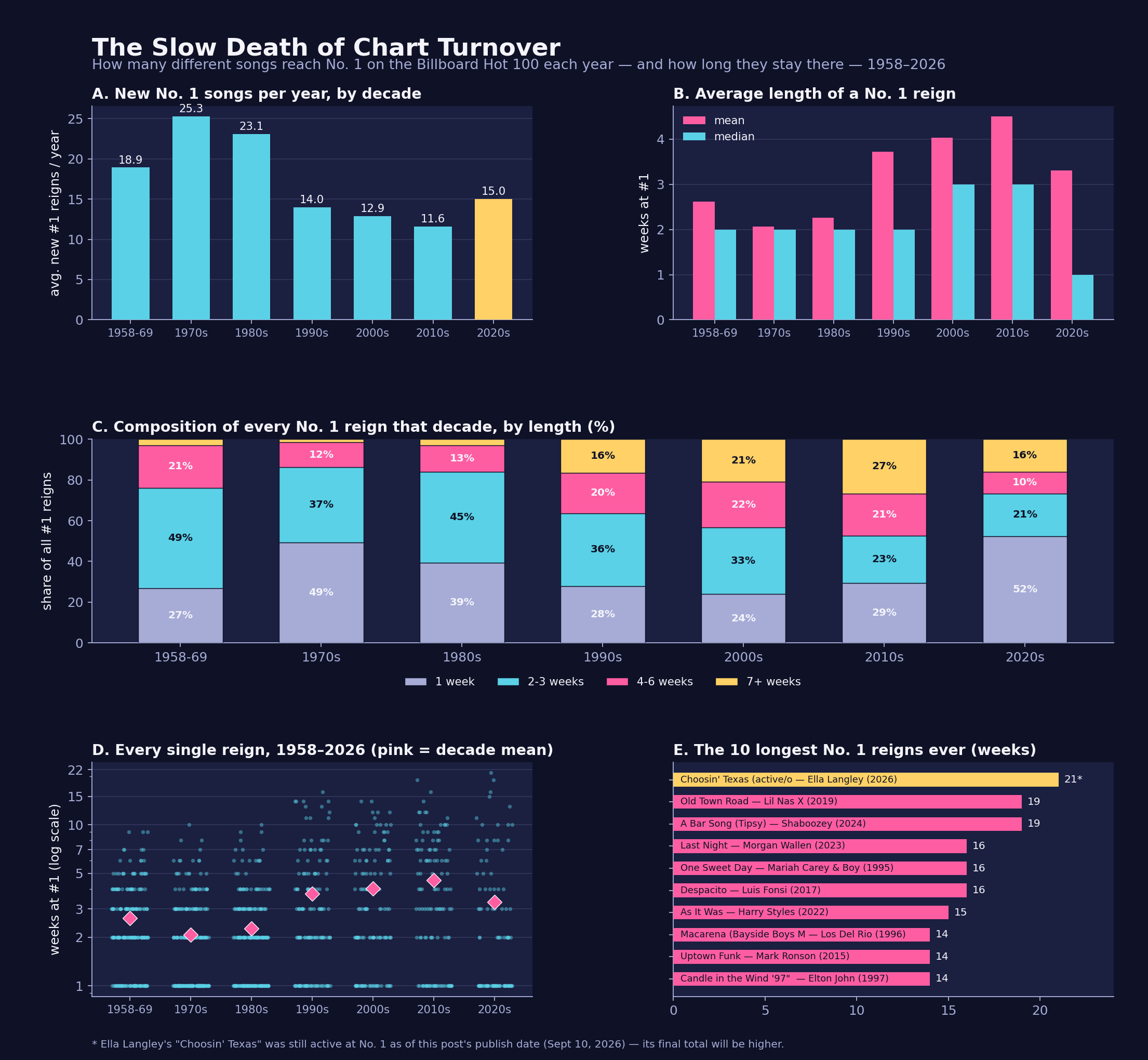
In the 1970s, a fresh song hit No. 1 on the Billboard Hot 100 roughly every two weeks, like clockwork — 25.3 different songs topped the chart in an average year. In the 2010s that dropped to 11.6 new No. 1s a year, less than half the churn. And of the ten longest-running No. 1 reigns in the Hot 100's 68-year history, seven happened in the last twelve years.
The dataset
Data comes from Wikipedia's Hot 100 number-one pages, broken out by era (1970s, 1980s, 1990s, 2000s, 2010s, 2020s), each sourced back to Billboard's own charts and Joel Whitburn's Billboard chart-history books.
The method
- Pulled the full No. 1 table from each of the seven Wikipedia decade pages above (artist, song, date, weeks at No. 1) — 1,201 rows total.
- Cleaned and combined them into one table, tagging every row with its decade (the 1958–1969 span is grouped as one 12-year bucket to match how Wikipedia itself splits the pre-1970 era).
- For each decade, computed how many different songs reached No. 1 per year on average (turnover), the mean and median length of a reign, and what share of all reigns fell into four length buckets: 1 week, 2–3 weeks, 4–6 weeks, and 7+ weeks.
- Cross-checked standout numbers — Boyz II Men's 13-week "End of the Road," Chubby Checker's two separate "The Twist" runs, Mariah Carey's cumulative Christmas total — against independent Billboard and press reporting before trusting them. That check caught a real scraping error: Wikipedia's table briefly gave "The Twist" 11 and 21 weeks for its two runs, a footnote-concatenation artifact. The real, well-documented figures are 1 week (1960) and 2 weeks (1962); the dataset was corrected before analysis.
What it showed
Turnover has roughly halved since the 1970s. New No. 1 songs per year fell from 25.3 (1970s) and 23.1 (1980s) to just 11.6 in the 2010s, the low point of the whole 68-year run. The 2020s (through September 2026) have ticked back up to 15.0/year — a real reversal, not just noise from a short sample.
Average reigns got longer, especially 1990s–2010s. Mean weeks-at-No.-1 climbed from roughly 2.1–2.6 weeks in every decade before 1990 to 3.7 (1990s), 4.0 (2000s), and a peak of 4.5 (2010s). Medians barely moved (2 to 3 weeks) — the mean is being pulled up by a growing number of genuine mega-hits, not by every song running longer.
The real story is polarization, not just "longer." Breaking every reign into length buckets shows the share of 7+ week mega-hits rising from 1.6–3.1% in 1958–1989 to 16–27% from 1990 onward. At the same time, the share of one-week flukes — after bottoming out around 24–28% in the 1990s–2000s — jumped back up to 52% in the 2020s, the highest of any decade in the dataset, even higher than the 1970s (49%). The middle ground (2–6 week reigns) is shrinking: today's No. 1 spot is more likely than ever to be either a one-week blip or a months-long takeover, rarely something in between.
The ten longest reigns in history are mostly recent. Only three of the top ten predate 2015 (1995, 1996, 1997); five are from 2019 or later.
| Song | Artist | Year | Weeks |
|---|---|---|---|
| Choosin' Texas* | Ella Langley | 2026 | 21 (active) |
| Old Town Road | Lil Nas X | 2019 | 19 |
| A Bar Song (Tipsy) | Shaboozey | 2024 | 19 |
| Last Night | Morgan Wallen | 2023 | 16 |
| One Sweet Day | Mariah Carey & Boyz II Men | 1995 | 16 |
| Despacito | Luis Fonsi & Daddy Yankee | 2017 | 16 |
| As It Was | Harry Styles | 2022 | 15 |
| Macarena (Bayside Boys Mix) | Los Del Río | 1996 | 14 |
| Uptown Funk | Mark Ronson ft. Bruno Mars | 2015 | 14 |
| Candle in the Wind '97 | Elton John | 1997 | 14 |
As of this post's research date (September 10, 2026), Ella Langley's "Choosin' Texas" was still actively sitting at No. 1 with 21 weeks logged and climbing — it may pass Mariah Carey's all-time record of 22 weeks before this post is even read. (Small Latin-crossover note, since it's one of Track Record's recurring threads: "Despacito" remains the highest-charting Spanish-language hit in Hot 100 history and earned its top-ten spot here purely on its own chart merits.) Two totals didn't fully reconcile during fact-checking: summing Wikipedia's own year-by-year rows for Mariah Carey's holiday song gives 20 cumulative weeks at No. 1 (2019–2025), while Billboard's own reporting puts it at a record 22 — a small gap likely tied to how a chart week straddling late December and early January gets attributed to a calendar year, shown here rather than quietly corrected.