Do Club Remixes Actually Hit Harder Than the Original?
You know the moment: a song you already like comes back six months later as a "Remix," suddenly louder, faster, more built for a dance floor. It feels more intense. But is that actually true, according to Spotify's own numbers — or is it just louder mixing and a new drop?
The dataset
This uses Spotify's audio-feature data (danceability, energy, tempo, valence, etc.) as published in the TidyTuesday "Spotify Songs" dataset (2020-01-21), originally pulled via the Spotify API and released under a public/CC0 license. The full dataset has 32,833 tracks.
For this post I worked from a 40-track sample pulled from three Spotify "Pop Remix," "Dance Pop," and "Dance Room" playlists — chosen specifically because several songs show up in both their original and remixed form, which is what makes a real comparison possible. The full working data and code for this post are in the Track Record GitHub repo, or grab the full 32,833-track dataset from the link above to run your own version.
The method
Using Python (pandas + matplotlib):
- Flagged any track with "Remix" in its title.
- Stripped remix suffixes to recover a "base title," then grouped by artist + base title to find songs with both an original and at least one remix in the sample.
- Compared Spotify's energy score (0–1, how intense/fast a track feels) between each matched pair.
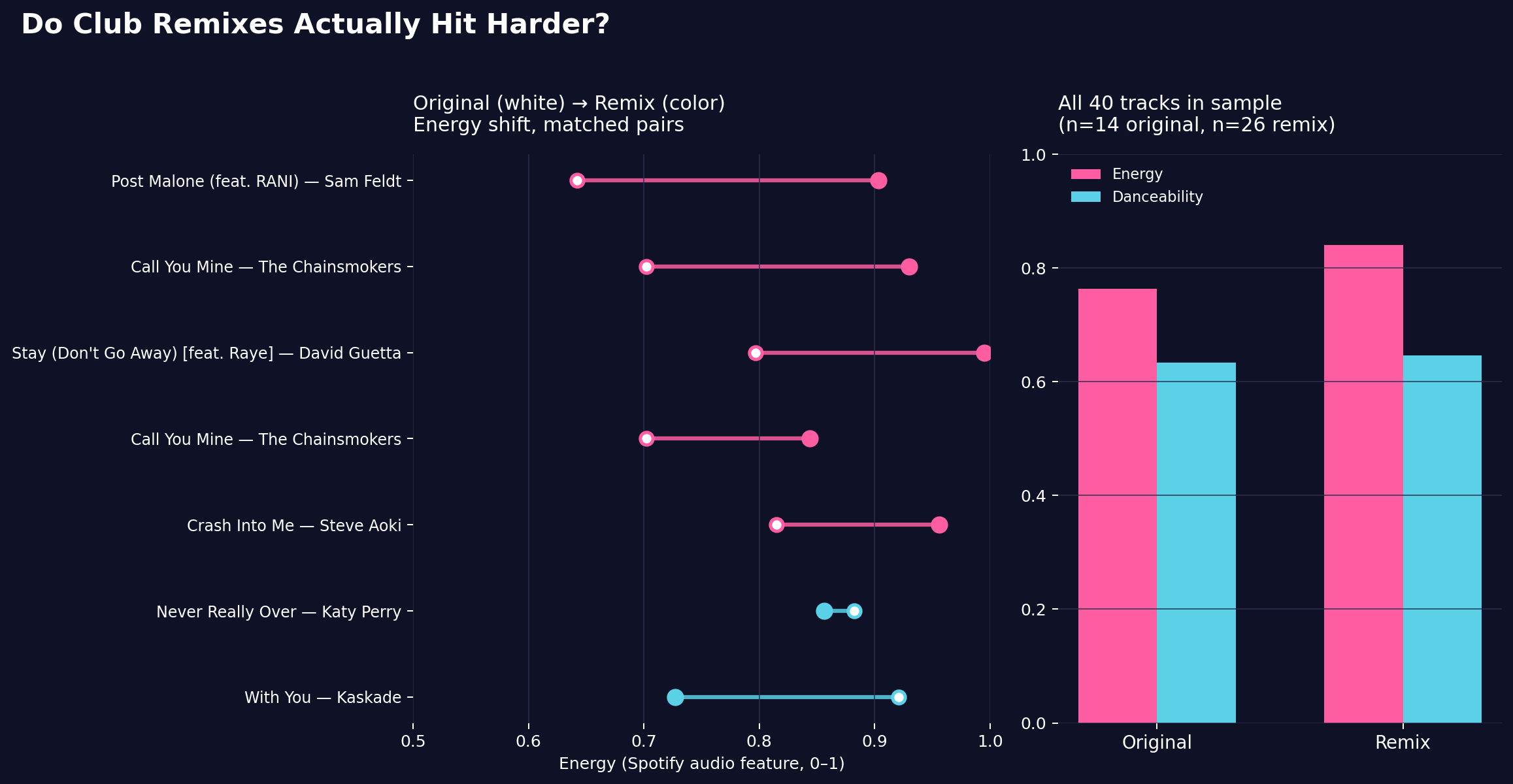
- Charted the shift per song (slope chart) and the overall group averages across all 40 tracks.
What the matched pairs showed
| Song | Remix | Original energy | Remix energy | Change |
|---|---|---|---|---|
| Post Malone (feat. RANI) — Sam Feldt | GATTÜSO Remix | 0.642 | 0.903 | +0.261 |
| Call You Mine — The Chainsmokers | Keanu Silva Remix | 0.702 | 0.930 | +0.228 |
| Stay (Don't Go Away) — David Guetta | Mark Knight Remix | 0.797 | 0.995 | +0.198 |
| Call You Mine — The Chainsmokers | Asketa & Natan Chaim Remix | 0.702 | 0.844 | +0.142 |
| Crash Into Me — Steve Aoki | Settle Down Steavis Aoki Remix | 0.815 | 0.956 | +0.141 |
| Never Really Over — Katy Perry | R3HAB Remix | 0.882 | 0.856 | −0.026 |
| With You — Kaskade | LöKii Remix | 0.921 | 0.727 | −0.194 |
5 of the 7 matched pairs got a higher energy score in remix form — sometimes by a lot (Post Malone/Sam Feldt jumped +0.26). But two went the other way: Kaskade's "With You" is actually calmer as the LöKii remix than the original. Across the full 40-track sample, remixes averaged 0.840 energy vs. 0.763 for originals — a real but not universal bump.